Project Overview


Tools:
Figma
ScoutBase: Role-based networking platform for hockey discovery
Designing for trust before launch
ScoutBase is a project focused on improving how players are discovered and connected in junior, collegiate, and professional hockey. Instead of starting with a large feature set, the focus is on whether this can actually change behavior in an industry where reputation and discretion matter.
I’m leading product discovery, UX structure, and system design for ScoutBase, a verified networking platform for players, representatives, coaches, and organizations. My role involves defining the core problem, talking directly with people in the industry, designing role-based systems, scoping the MVP, and creating early monetization decisions.
Player discovery in hockey is messy and uneven. Opportunities often rely on agent relationships, spreadsheets, or word of mouth, which favors players who are already well connected. Any tool in this space has to influence real career decisions, not just add another profile to manage.
Based on what I learned from building Golf Lounge, ScoutBase is intentionally pre-launch. The goal wasn’t to build fast, but to confirm the product was worth building at all.


Discovery insights & system-level decisions
ScoutBase started with a simple constraint: in hockey, showing interest too early can potentially hurt a player’s position. A conversation with a professional player made this clear almost immediately, and it shaped everything that came after.
Because of that, ScoutBase isn’t designed like a traditional social network. It’s built as a professional discovery tool where privacy and timing matter more than visibility or engagement. Growth will be slower by design, but the tradeoff is a product people actually feel safe using.
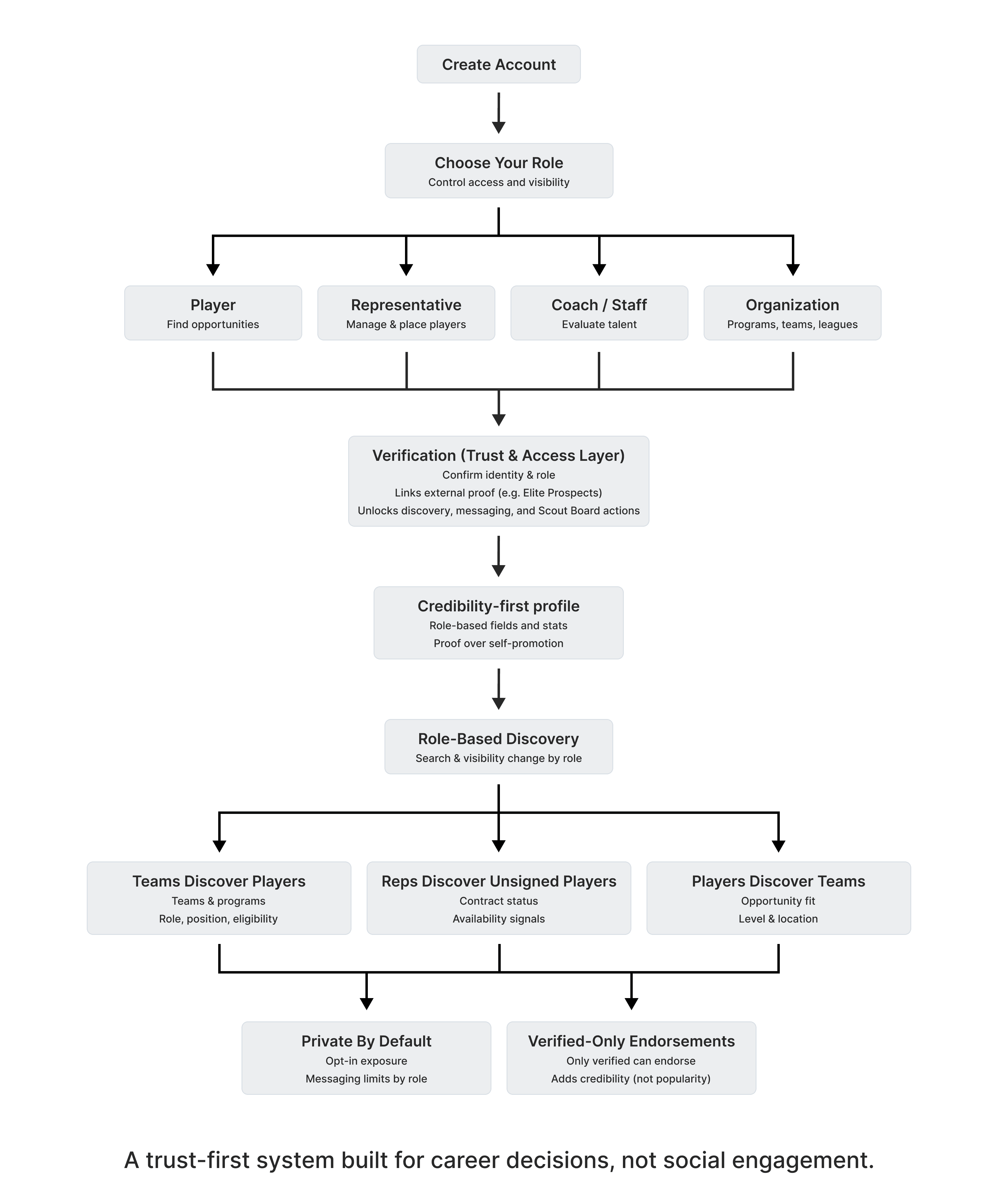
Instead of followers, the platform uses connections. Messaging, referrals, and tagging only unlock when there’s mutual intent, which keeps interactions intentional rather than performative. Trust is built into the system. Only verified accounts can endorse others, and profiles clearly show whether someone is a player, representative, coach, or organization.
Discovery adapts to the person doing the searching. Players, teams, and representatives see different filters because they’re looking for different things. This reduces blind outreach and makes finding the right opportunities more focused. The home feed exists to support discovery, not compete with social platforms, and is designed to stay intentional rather than attention-driven.
The diagram below shows how these decisions come together, from roles and verification to how discovery and visibility work across the platform.

Discovery insights & system-level decisions
ScoutBase started with a simple constraint: in hockey, showing interest too early can potentially hurt a player’s position. A conversation with a professional player made this clear almost immediately, and it shaped everything that came after.
Because of that, ScoutBase isn’t designed like a traditional social network. It’s built as a professional discovery tool where privacy and timing matter more than visibility or engagement. Growth will be slower by design, but the tradeoff is a product people actually feel safe using.
Instead of followers, the platform uses connections. Messaging, referrals, and tagging only unlock when there’s mutual intent, which keeps interactions intentional rather than performative. Trust is built into the system. Only verified accounts can endorse others, and profiles clearly show whether someone is a player, representative, coach, or organization.
Discovery adapts to the person doing the searching. Players, teams, and representatives see different filters because they’re looking for different things. This reduces blind outreach and makes finding the right opportunities more focused. The home feed exists to support discovery, not compete with social platforms, and is designed to stay intentional rather than attention-driven.
The diagram below shows how these decisions come together, from roles and verification to how discovery and visibility work across the platform.

Discovery insights & system-level decisions
ScoutBase started with a simple constraint: in hockey, showing interest too early can potentially hurt a player’s position. A conversation with a professional player made this clear almost immediately, and it shaped everything that came after.
Because of that, ScoutBase isn’t designed like a traditional social network. It’s built as a professional discovery tool where privacy and timing matter more than visibility or engagement. Growth will be slower by design, but the tradeoff is a product people actually feel safe using.
Instead of followers, the platform uses connections. Messaging, referrals, and tagging only unlock when there’s mutual intent, which keeps interactions intentional rather than performative. Trust is built into the system. Only verified accounts can endorse others, and profiles clearly show whether someone is a player, representative, coach, or organization.
Discovery adapts to the person doing the searching. Players, teams, and representatives see different filters because they’re looking for different things. This reduces blind outreach and makes finding the right opportunities more focused. The home feed exists to support discovery, not compete with social platforms, and is designed to stay intentional rather than attention-driven.
The diagram below shows how these decisions come together, from roles and verification to how discovery and visibility work across the platform.


Assumptions, validation & what success means
ScoutBase is built around a few core beliefs: players are more likely to participate when exposure risk is low, verification matters more than open access, and real opportunities form through coaches and staff, not just agents. The free version also has to be useful on its own before any upgrade makes sense.
Instead of validating these ideas through interviews alone, they’re tested through the product itself. Limits on connections, posting, stats, endorsements, and search are all intentional. Free users are still part of a meaningful experience, while PRO removes friction where reach or efficiency actually matter. The goal is to create a clear reason to upgrade without turning trust into something you have to pay for.
I’m also looking into additional credibility for more established users, like current NCAA or professional players. The challenge is reducing noise for decision-makers without pushing out underdogs or underrepresented players, something that has to be implemented and shaped carefully.
ScoutBase reuses the same design system and technical foundation as Golf Lounge, which helped me move faster on UI and spend more time on harder problems like trust, visibility, and discovery logic. While parts of the interface may feel familiar, the incentives behind each decision are very different.
Success for ScoutBase isn’t about replacing what exists for the current system. It’s about fitting naturally into how hockey already works and influencing behavior in small but meaningful ways – fewer blind messages, more targeted outreach, and players feeling safe looking for options without the fear of public risk.
Overall, this project reflects a more intentional way of building products: validating the problem first, designing around real constraints, and prioritizing trust and early value over feature depth.
Assumptions, validation & what success means
ScoutBase is built around a few core beliefs: players are more likely to participate when exposure risk is low, verification matters more than open access, and real opportunities form through coaches and staff, not just agents. The free version also has to be useful on its own before any upgrade makes sense.
Instead of validating these ideas through interviews alone, they’re tested through the product itself. Limits on connections, posting, stats, endorsements, and search are all intentional. Free users are still part of a meaningful experience, while PRO removes friction where reach or efficiency actually matter. The goal is to create a clear reason to upgrade without turning trust into something you have to pay for.
I’m also looking into additional credibility for more established users, like current NCAA or professional players. The challenge is reducing noise for decision-makers without pushing out underdogs or underrepresented players, something that has to be implemented and shaped carefully.
ScoutBase reuses the same design system and technical foundation as Golf Lounge, which helped me move faster on UI and spend more time on harder problems like trust, visibility, and discovery logic. While parts of the interface may feel familiar, the incentives behind each decision are very different.
Success for ScoutBase isn’t about replacing what exists for the current system. It’s about fitting naturally into how hockey already works and influencing behavior in small but meaningful ways – fewer blind messages, more targeted outreach, and players feeling safe looking for options without the fear of public risk.
Overall, this project reflects a more intentional way of building products: validating the problem first, designing around real constraints, and prioritizing trust and early value over feature depth.
Assumptions, validation & what success means
ScoutBase is built around a few core beliefs: players are more likely to participate when exposure risk is low, verification matters more than open access, and real opportunities form through coaches and staff, not just agents. The free version also has to be useful on its own before any upgrade makes sense.
Instead of validating these ideas through interviews alone, they’re tested through the product itself. Limits on connections, posting, stats, endorsements, and search are all intentional. Free users are still part of a meaningful experience, while PRO removes friction where reach or efficiency actually matter. The goal is to create a clear reason to upgrade without turning trust into something you have to pay for.
I’m also looking into additional credibility for more established users, like current NCAA or professional players. The challenge is reducing noise for decision-makers without pushing out underdogs or underrepresented players, something that has to be implemented and shaped carefully.
ScoutBase reuses the same design system and technical foundation as Golf Lounge, which helped me move faster on UI and spend more time on harder problems like trust, visibility, and discovery logic. While parts of the interface may feel familiar, the incentives behind each decision are very different.
Success for ScoutBase isn’t about replacing what exists for the current system. It’s about fitting naturally into how hockey already works and influencing behavior in small but meaningful ways – fewer blind messages, more targeted outreach, and players feeling safe looking for options without the fear of public risk.
Overall, this project reflects a more intentional way of building products: validating the problem first, designing around real constraints, and prioritizing trust and early value over feature depth.